
Google has initiated its traditional November update cycle, delivering essential security patches and feature rollouts across the Android ecosystem, Chrome browser, and Google Search. The updates, released around November 6, 2025, focus heavily on tightening security, enhancing quality-of-life features for users, and simplifying the backend documentation for web developers.
1. Android and System Security Updates
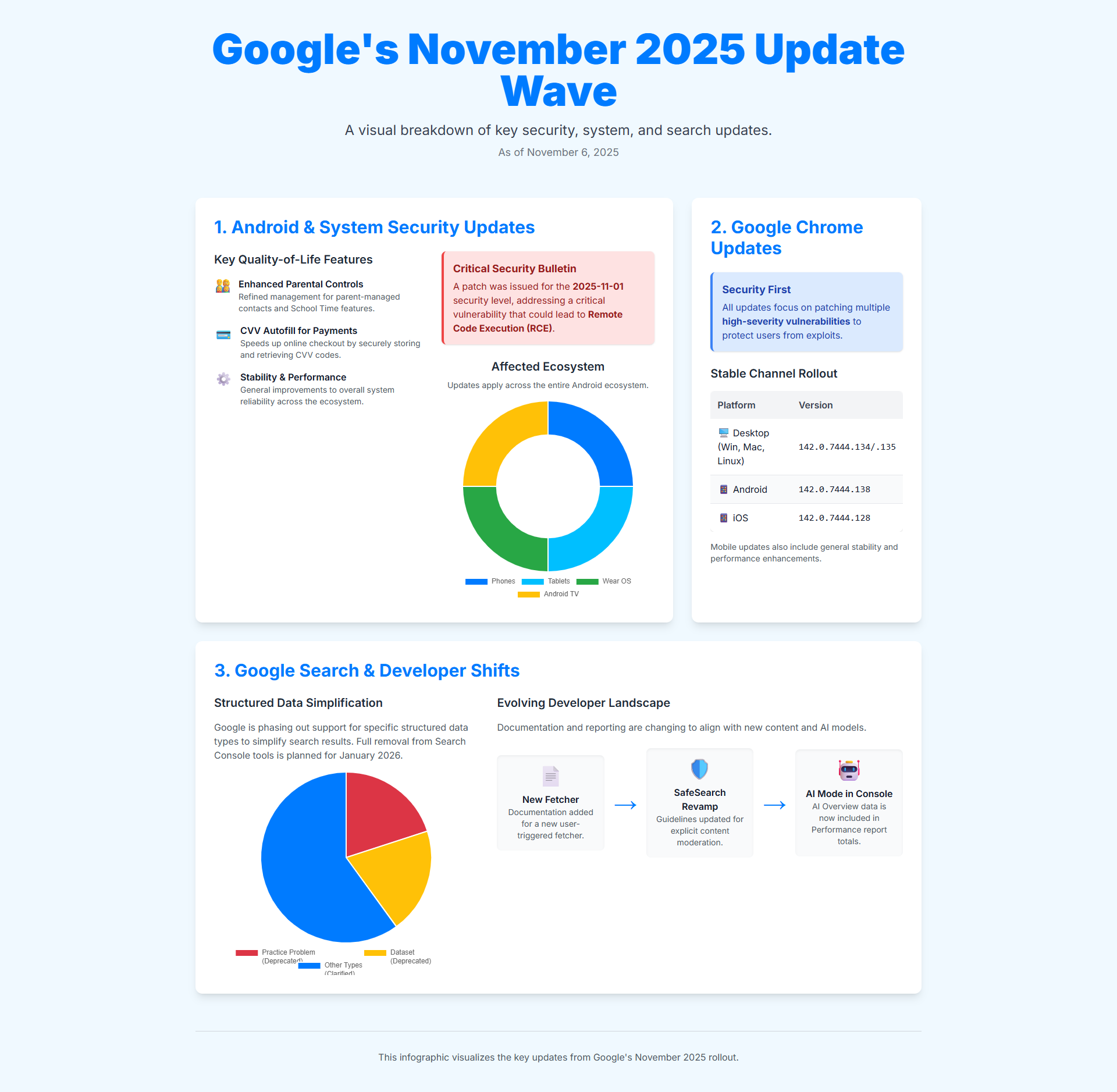
The core of the November rollout focuses on enhancing the security and stability of the vast Android ecosystem, which encompasses phones, tablets, Wear OS, and Android TV.
November 2025 Google System Update
This system update introduces several crucial quality-of-life features aimed at making Android devices more secure and user-friendly:
- Enhanced Stability and Performance: General improvements are deployed across the platform, targeting the overall reliability of the operating system.
- Enhanced Parental Controls: For supervised accounts, Google has refined controls related to managing parent-managed contacts and the School Time features, making supervision tools smoother and easier to navigate for parents.
- CVV Autofill for Payments: A major convenience update brings CVV storage and retrieval support to Android Autofill. This secure implementation dramatically speeds up online checkout processes by eliminating the need to manually enter the three-digit security code repeatedly, improving the seamless payment experience integrated with Google Wallet.
Android Security Bulletin
The most critical component of the system updates is the November 2025 Android Security Bulletin. Devices running the 2025-11-01 security patch level (or later) are protected against several security vulnerabilities. The most severe issue addressed is a critical vulnerability in the Android system components that could potentially lead to remote code execution (RCE). Such flaws are among the most serious, as they allow an attacker to execute malicious code without needing additional privileges or user interaction for exploitation. Users are strongly advised to install this patch as soon as possible.
2. Google Chrome: Focused on Stability and Security
Google’s web browser received urgent patches across all major platforms, with the focus remaining on resolving high-severity vulnerabilities before they can be exploited in the wild.
- Stable Channel Update for Desktop: Version 142.0.7444.134/.135 was released for Windows, Mac, and Linux. This update is a crucial security maintenance release that includes fixes for several high-severity vulnerabilities. These often target core browser components, such as the V8 JavaScript engine and WebGPU, which, if exploited, can lead to arbitrary code execution or memory corruption.
- Chrome for Mobile Platforms: Separate stable channel updates were released for mobile users:
- Chrome for Android (Version 142.0.7444.138)
- Chrome for iOS (Version 142.0.7444.128)
Both mobile updates primarily concentrated on delivering enhanced stability and performance improvements, ensuring a smoother browsing experience across smartphones and tablets.
3. Google Search and Developer Documentation Shifts
In a move aimed at simplifying the Search landscape and adapting to new AI-driven realities, Google also announced significant updates to its developer documentation and Search Console reporting.
Deprecation of Structured Data Types
Google is strategically phasing out support for certain structured data types to simplify the search result page experience. The company confirmed the deprecation of both “practice problem” and “dataset” structured data types. Although support has been officially removed from the documentation, its complete removal from Search Console tools is scheduled for January 2026. This change indicates a move toward a more curated set of rich results that Google believes offers the most value to users.
Documentation Changes and New Fetcher
In addition to removing deprecated types, Google’s documentation was updated to remove and clarify certain existing structured data types. Furthermore, documentation for a new user-triggered fetcher was introduced, suggesting new mechanisms by which Google can crawl and index content based on user interaction signals.
SafeSearch and AI Mode Integration
- SafeSearch Documentation Revamp: The guidelines for sites containing explicit content were fully revamped. The new documentation aligns best practices with current policies and algorithmic protections, emphasizing new best practices for content moderation and the handling of non-consensual content.
- AI Mode Data in Search Console: A significant developer-facing change is the inclusion of performance data from AI Mode (AI Overviews) in the Search Console Performance report totals. This means that web admins can now see the combined impact of traditional and AI-generated search results on their website traffic metrics, providing a more comprehensive view of search performance.
These November 2025 updates collectively highlight Google’s commitment to security across its platforms, while simultaneously streamlining its developer ecosystem to match evolving search methodologies and user demands.






2025 Md. Mojahid Shaikh. All Rights Reserved.