
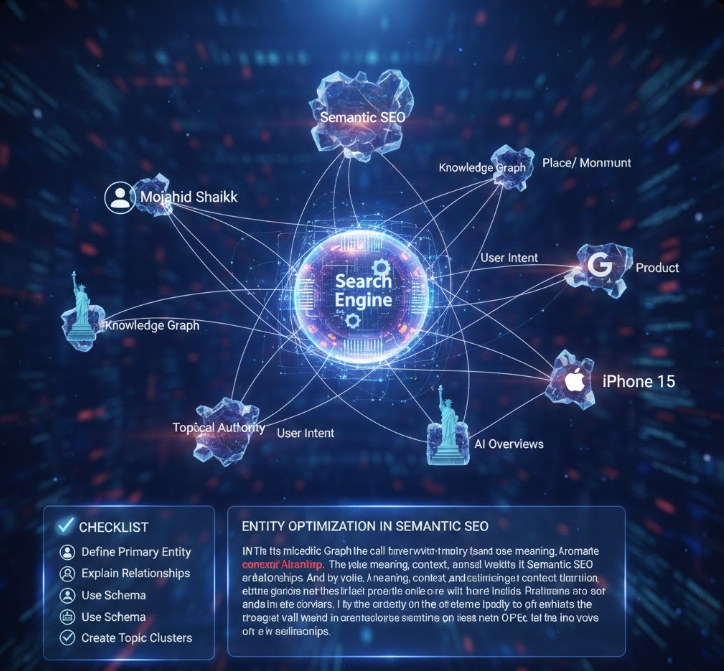
Entity Optimization is a modern SEO strategy that focuses on meaning, context, and relationships rather than just keywords. It helps search engines understand what your content is truly about by clearly defining entities and their relationships.
As search engines evolve, ranking is no longer about repeating keywords. It is about demonstrating topical authority through entities, concepts, and real-world knowledge.
What Is an Entity in SEO?
In SEO, an entity is a uniquely identifiable thing that exists independently and can be clearly defined. Search engines recognize entities through knowledge graphs and semantic connections.
Common entity types include:
- Mojahid Shaikh → Person
- Statue of Liberty → Place/Monument
- Search Engine Optimization (SEO) → Concept/Topic
- Google → Brands
- iPhone 15 → Product
An entity is not just a keyword. It represents meaning, attributes, and relationships that search engines can understand and connect to other known entities.
How Search Engines Use Entities
Search engines use entities to move beyond simple keyword matching and toward a proper understanding of meaning, context, and intent. Instead of treating words as isolated strings of text, search engines identify entities as real-world concepts and map how they relate to each other.
Below is a detailed explanation of how this works.
1. Understanding Context Instead of Exact Wording
Entities allow search engines to understand what a query or page is actually about, even when different words or phrases are used.
For example:
- “Best phone by Apple”
- “Latest iPhone model”
- “Apple smartphone 2025”
All three queries refer to the same primary entity: Apple iPhone.
Because search engines recognize the entity, they do not need an exact keyword match. They can interpret synonyms, variations, and natural-language expressions to deliver relevant results.
This is especially important for:
- Voice search
- Conversational queries
- AI-driven search experiences
2. Reducing Ambiguity in Search Queries
Many words have multiple meanings. Entities help search engines disambiguate these terms by analyzing context.
Examples:
- “Jaguar” could refer to an animal, a car brand, or a sports team
- “Apple” could mean a fruit or a technology company
Search engines use entity signals such as:
- Related terms
- User behavior
- Query history
- Geographic context
- Associated entities
By identifying the correct entity, search engines can return results that match the user’s true intent instead of guessing based on keywords alone.
3. Connecting Related Topics and Concepts
Entities exist within a network of relationships, not in isolation. Search engines use these relationships to understand how topics connect.
For example, the entity Search Engine Optimization may be linked to:
- Ranking factors
- Technical SEO
- Content marketing
- Search intent
- Backlinks
When your content naturally and accurately includes related entities, search engines recognize it as topically complete. This allows your page to rank for a broader range of associated queries, even if those exact phrases are not present in the text.
4. Improving Result Relevance Based on User Intent
Entities help search engines align content with user intent, which is one of the most important ranking factors today.
Search intent generally falls into categories such as:
- Informational
- Navigational
- Commercial
- Transactional
By understanding entities, search engines can determine:
- What the user wants to know
- What type of content best satisfies that need
- Which pages demonstrate the highest relevance and authority
This ensures users receive results that solve their problem, not just pages that repeat the query.
5. Powering the Knowledge Graph
Google stores entity information in its Knowledge Graph, a massive database that contains:
- Entities
- Attributes
- Facts
- Relationships
The Knowledge Graph allows Google to:
- Display knowledge panels
- Generate featured snippets
- Answer direct questions
- Connect information across different sources
- Support AI-driven and generative search results
When your content clearly defines entities and their relationships, it becomes easier for Google to integrate your page into this system.
6. Supporting AI and Semantic Search Systems
Modern search systems use:
- Natural Language Processing (NLP)
- Machine learning
- Large language models
These systems rely heavily on entities to understand:
- Topic relevance
- Content accuracy
- Contextual depth
- Authority signals
Entity-optimized content is more likely to be used in AI summaries, voice assistants, and search-generated answers because it provides structured meaning rather than isolated keywords.
Summary
Search engines use entities to:
- Understand the meaning instead of the words
- Eliminate ambiguity in queries
- Connect topics into semantic networks
- Match results to real user intent
- Power knowledge panels and AI search features
Entity understanding is the foundation of how modern search engines interpret content. Optimizing for entities ensures your content is not just indexed, but fully understood and accurately ranked.
How Search Engines Use Entities
Search engines use entities to understand content at a conceptual level, rather than relying only on exact keyword matches. This shift allows them to deliver more accurate, relevant, and intent-driven search results.
Understanding Context Instead of Exact Wording
Entities help search engines recognize the meaning behind words. Different phrases can describe the same entity, and search engines can interpret them as equivalent even when the wording changes. This allows results to remain relevant even when users phrase queries differently or use natural language.
Reducing Ambiguity in Search Queries
Many words have multiple meanings. Entities allow search engines to identify the intended meaning by analyzing surrounding context, related concepts, and user signals. This ensures that results align with the user’s actual intent rather than showing irrelevant interpretations of the same word.
Connecting Related Topics and Concepts
Entities exist within a network of relationships. Search engines use these connections to understand how topics relate to one another. When content includes relevant, well-explained entities, it signals topical completeness and helps pages rank for a broader range of related queries.
Improving Result Relevance Based on User Intent
By understanding entities, search engines can better determine what users are trying to accomplish with a search. Whether the intent is informational, navigational, or transactional, entity recognition helps match users with content that best satisfies their needs.
Powering the Knowledge Graph
Google stores entity information in its Knowledge Graph, a structured database of people, places, organizations, concepts, and their relationships. This system enables Google to answer direct questions, display knowledge panels, generate rich results, and interpret content beyond simple text matching.
Key Elements of Entity Optimization
Entity Optimization works best when it is applied systematically. Each element below plays a specific role in helping search engines understand not just what your content says, but what it means.
1. Identify Core and Related Entities
The foundation of entity optimization is identifying the right entities before you start writing.
Primary Entity (Main Topic)
The primary entity is the central concept your page is about. This should be clear, focused, and aligned with search intent.
Example:
For this page, the primary entity is Entity Optimization.
Everything on the page should support, explain, or relate to this central entity.
Secondary Entities (Supporting Concepts)
Secondary entities are closely related concepts that help define, explain, or expand the primary entity.
Examples include:
- Semantic SEO
- Knowledge Graph
- Search intent
- Schema markup
- Natural language processing
These entities signal to search engines that your content covers the topic in depth rather than superficially.
Contextual Entities (Related Ideas and Associations)
Contextual entities provide real-world relevance and semantic connections. These may include:
- Brands (e.g., Google)
- Tools (e.g., schema.org)
- Technologies (e.g., machine learning)
- Industry concepts (e.g., topical authority)
Contextual entities help search engines place your content within a broader knowledge ecosystem.
Why This Matters
When search engines see multiple related entities used naturally and accurately, they can:
- Understand topic depth
- Reduce ambiguity
- Associate your page with a broader semantic topic cluster
- Rank your content for more related queries
2. Add Context and Explain Relationships
Simply mentioning entities is not enough. Search engines need context and relationships to understand meaning.
Explain Each Entity Clearly
Whenever you introduce an entity:
- Define what it is
- Explain its role
- Clarify why it matters in relation to the main topic
For example, instead of just mentioning “Schema markup,” explain that it helps search engines identify entities explicitly within structured data.
Describe How Entities Relate to Each Other
Entities rarely exist in isolation. Strong entity optimization explains relationships such as:
- Cause and effect
- Hierarchical relationships
- Functional connections
Example:
- Semantic SEO relies on entity optimization
- Entity optimization supports Knowledge Graph inclusion
- Schema markup strengthens entity recognition
These logical connections help search engines build accurate semantic models.
Use Natural, Human-Friendly Language
Avoid listing entities unnaturally. Instead:
- Integrate them into explanations
- Use them in examples
- Connect them through meaningful sentences
This improves both readability and semantic clarity.
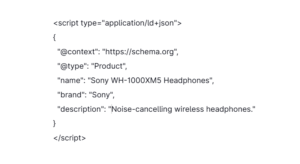
3. Use Structured Data (Schema Markup)
Structured data is one of the strongest signals for entity identification.
What Structured Data Does
Schema markup:
- Explicitly defines entities on your page
- Removes ambiguity
- Helps search engines understand entity attributes and relationships
While content explains meaning implicitly, schema explains it explicitly.
Standard Schema Types for Entity Optimization
Depending on your content, you may use:
- Article schema for blog posts
- Organization schema for brands or companies
- Person schema for authors or experts
- Product schema for commercial pages
- FAQ schema for question-based content
Each schema type reinforces entity signals and improves semantic accuracy.
Benefits of Using Schema Markup
- Better eligibility for rich results
- Stronger entity recognition
- Improved understanding by AI-driven search systems
- Enhanced visibility in SERP features
4. Create Comprehensive, Intent-Focused Content
Entity optimization works best when combined with search intent optimization.
Address Primary and Secondary User Intent
A well-optimized page should:
- Answer the main question clearly
- Address related follow-up questions
- Anticipate what users want to know next
This aligns your content with how search engines evaluate usefulness.
Cover the Topic Holistically
Entity-optimized content does not chase individual keywords. Instead, it:
- Explains the topic end-to-end
- Includes definitions, examples, benefits, and use cases
- Covers related subtopics naturally
This signals expertise and topical authority.
Avoid Keyword Stuffing
Overusing keywords weakens semantic clarity. Entity-focused content:
- Uses natural language
- Prioritizes meaning over repetition
- Reads smoothly for humans
Search engines now evaluate quality, not density.
Demonstrate Expertise and Depth
Search engines favor content that:
- Explains concepts clearly
- Shows understanding of relationships
- Uses accurate terminology
- Provides value beyond surface-level explanations
This is especially important for competitive topics.
5. Strengthen Internal and External Linking
Links help search engines understand how entities relate across the web.
Internal Linking for Entity Connections
Internal links:
- Connect related entities within your site
- Build topical clusters
- Signal content hierarchy and importance
Example:
A page on “Entity Optimization” should internally link to:
- Semantic SEO guides
- Schema markup tutorials
- Topical authority articles
This reinforces semantic structure.
External Linking for Authority and Context
External links:
- Associate your content with authoritative entities
- Strengthen credibility and trust
- Help search engines validate context
Linking to respected industry resources signals accuracy and relevance.
How Linking Supports Entity Optimization
Together, internal and external links help search engines:
- Map your site into broader topic networks
- Understand entity relationships at scale
- Recognize your content as part of an authoritative ecosystem
Summary
Effective Entity Optimization requires more than mentioning related terms. It involves:
- Strategic entity identification
- Clear explanations and relationships
- Structured data implementation
- Intent-focused, comprehensive content
- Strong internal and external linking
When done correctly, entity optimization transforms content from keyword-based pages into semantic assets that search engines understand, trust, and rank.
Benefits of Entity Optimization
Entity Optimization delivers both immediate and long-term SEO advantages by aligning your content with how modern search engines understand information. Instead of relying solely on keywords, it focuses on meaning, relationships, and intent — resulting in stronger, more sustainable performance.
Improved Search Relevance
Entity-optimized content better matches user intent because search engines understand what your content is actually about.
When entities are clearly defined and connected:
- Search engines can interpret the true meaning of a query
- Your content can rank for a broader range of relevant searches
- Ambiguous keywords are clarified through context
As a result, your pages appear in searches for semantically related terms, not just exact keyword matches, increasing overall visibility and organic traffic quality.
Stronger Topical Authority
Covering related entities signals subject-matter expertise to search engines.
When your content consistently addresses:
- Core concepts
- Supporting entities
- Related subtopics
Search engines recognize your site as an authoritative source within that topic area. This strengthens your topical authority, making it easier for both new and existing pages to rank over time.
Topical authority is critical in competitive niches, where depth and accuracy matter more than keyword frequency.
Better Performance in Rich Results
Entity optimization improves eligibility for enhanced search features, including:
- Knowledge panels
- Featured snippets
- FAQ results
- People Also Ask sections
- AI-generated search answers
Search engines rely heavily on entity data and structured understanding to generate these results. When your content clearly defines entities and their relationships, it becomes easier for search systems to extract and display your information prominently.
This increased SERP visibility often leads to higher click-through rates, even when rankings remain the same.
Future-Proof SEO Strategy
Entity-based optimization aligns naturally with the future of search.
Modern search systems are increasingly driven by:
- Artificial intelligence
- Natural language processing
- Voice search
- Generative and conversational search engines
These systems rely on entities rather than keywords to understand questions and deliver accurate answers. By optimizing content around entities now, you ensure your SEO strategy remains effective as search technology evolves.
Entity optimization helps your content stay relevant, adaptable, and competitive in an AI-driven search environment.
Entity Optimization Best Practices Checklist
Use this checklist to ensure your content is optimized for entities, semantic understanding, and modern search engines.
Define a Clear Primary Entity
Every page should focus on one clearly defined primary entity.
Best practices:
- Decide the main topic before writing
- Keep the page tightly aligned with that entity
- Avoid mixing multiple main issues on one page
- Reinforce the primary entity in the title, headings, and introduction
Search engines need a clear signal about what the page is primarily about. A focused entity improves relevance and ranking potential.
Include Relevant Supporting Entities
Supporting entities help search engines understand the depth and context of a topic.
Best practices:
- Add entities that naturally support the main topic
- Include concepts users expect to see when searching for the topic
- Avoid adding unrelated or forced entities
- Use entities that genuinely improve understanding
Supporting entities demonstrate comprehensive coverage rather than shallow optimization.
Explain Relationships Between Concepts
Entity optimization is about connections, not just mentions.
Best practices:
- Explain how each entity relates to the primary topic
- Use cause-and-effect, hierarchical, or functional relationships
- Connect entities through meaningful explanations
- Avoid listing entities without context
Clear relationships help search engines build accurate semantic models of your content.
Use Structured Data Where Appropriate
Structured data strengthens entity recognition.
Best practices:
- Use schema markup that matches the content type
- Implement Article, Organization, Person, Product, or FAQ schema as needed
- Ensure structured data accurately reflects the content
- Avoid spammy or misleading schema usage
Structured data helps search engines explicitly identify entities and their attributes.
Create Topic Clusters, Not Isolated Pages
Entity optimization works best at the site level, not just the page level.
Best practices:
- Build pillar pages around core entities
- Create supporting articles for related entities
- Link cluster content back to the main topic
- Maintain logical site structure and hierarchy
Topic clusters strengthen topical authority and improve crawlability.
Focus on Meaning Over Repetition
Avoid keyword stuffing. Prioritize clarity and meaning.
Best practices:
- Use natural language instead of repetitive phrases
- Explain concepts clearly rather than repeating terms
- Use synonyms and variations naturally
- Write for understanding, not density
Search engines evaluate content quality based on meaning, not frequency.
Optimize for User Understanding First
Entity optimization succeeds when content serves users.
Best practices:
- Answer real user questions clearly
- Use simple explanations for complex concepts
- Structure content for readability
- Provide examples, definitions, and summaries
When users can easily understand your content, search engines are more likely to trust and rank it.
Quick Entity Optimization Audit Checklist
Before publishing or updating content, ask:
- Is the primary entity clear?
- Are supporting entities relevant and explained?
- Are relationships between concepts easy to understand?
- Is structured data correctly implemented?
- Does the content fit into a topic cluster?
- Does the page prioritize meaning and user value?
If the answer is yes to all, your content is well-optimized for entities.
Final Thoughts
Entity Optimization has become a foundational pillar of modern Semantic SEO. Search engines no longer rank content based solely on keyword presence; they rank content that they can clearly understand, contextualize, and trust.
By optimizing for entities, you enable search engines to accurately interpret your content, connect it to real-world concepts, and align it with genuine user intent. This shift transforms your pages from simple keyword targets into meaningful, authoritative resources.
For brands, publishers, and SEO professionals focused on sustainable growth, entity optimization is no longer optional. It is a critical strategy for achieving long-term visibility, relevance, and resilience in an AI-driven search ecosystem.
1 Comment
Leave A Comment






2025 Md. Mojahid Shaikh. All Rights Reserved.
January 1, 2026
why entity is important?